Who Owns the Customer in the Age of AI?
25 min read
25 min read
“Who owns the customer?” isn’t a new question. Organizations have debated it for decades.
Marketing may own customer strategy and engagement. Sales owns much of the commercial relationship. Service owns critical moments in the customer experience. Commerce owns transactions. Product increasingly owns the digital experience.
In most organizations, the practical answer has been some version of everyone—and no one.
That ambiguity hasn’t prevented companies from operating. But AI may make it much harder to sustain.
As AI moves from helping employees create and analyze toward making decisions and taking actions, it can increasingly operate across the functional boundaries companies have traditionally built around the customer.
That creates an opportunity to make better decisions across the customer relationship—and raises a more consequential version of the old question:
"Who owns the customer decision when AI operates across functions?"
Customer decisions are still largely made inside functional boundaries
Consider how companies engage with customers today.
Marketing determines which audiences to target, which messages to send and when to engage.
Sales decides which opportunities or accounts require attention.
Service prioritizes customer issues and determines how they should be resolved.
Commerce recommends products, offers and promotions.
Product and Customer Success teams increasingly influence onboarding, adoption and digital engagement.
Each function has its own objectives, systems, data and metrics, and each can make a perfectly rational decision within its own domain.
The problem is that customers don’t experience the company as a collection of functional departments. They don’t distinguish between a marketing message, a sales call, a service interaction and a product notification. They’re all interactions with the same company, and customers increasingly expect the company to understand the broader relationship—not just the part visible to an individual function.
As AI becomes increasingly capable of understanding the broader customer relationship, it creates the possibility of moving beyond the next-best action within a function toward something potentially more valuable: the next-best enterprise action.
By “next-best enterprise action,” I mean the best next action determined across the customer relationship and against the broader objectives of the business, rather than within the boundaries of a single function. That action might ultimately be executed through Marketing, Sales, Service, Commerce or Product—or the best decision may be to take no action at all.
What is the best thing for the company to do next?
Consider a high-value customer whose likelihood of repurchase has begun to decline.
They have an unresolved customer-service issue.
They recently viewed a product they’ve purchased before.
The price of that product has increased, and it’s currently unavailable.
A recent promotional offer didn’t generate engagement.
Their preferred communication channels are known.
Another automated process contacted them yesterday.
A mature customer platform may already contain much of this information or be able to access it.
And increasingly, a capable AI shouldn’t need a marketer to separately ask:
Should we contact this customer?
Why haven’t they repurchased?
What retention offer should we make?
Given sufficient context, the AI should increasingly be able to reason across those questions itself.
It might conclude that the customer’s declining repurchase probability doesn’t necessarily indicate deteriorating loyalty.
Recent product browsing suggests continued interest.
Product availability or the price increase may be suppressing purchase.
The unresolved service issue makes another promotional message potentially inappropriate.
And recent automated engagement suggests another immediate interaction could make the experience worse rather than better.
The best next action might therefore not be a marketing action at all.
It could be to prioritize the service issue, wait for the product to become available, prompt another part of the organization to act, or simply do nothing for now.
That is a fundamentally different conception of next-best action.
The question becomes: What is the best thing for the company to do next with this customer? Not simply the best thing for Marketing, Sales or Service, but the best enterprise action given the customer and business circumstances.
The difficult word is “best”
This sounds straightforward until we ask what best actually means.
Revenue? Margin? Conversion?
Retention? Customer lifetime value? Customer experience?
Service resolution? Product adoption? Brand?
Those objectives won’t always point toward the same action.
A marketing system might identify a high-value customer with declining repurchase probability and recommend an aggressive retention offer. A service system might recommend suppressing commercial communication until the customer’s problem is resolved. Commerce might identify continued purchase intent and recommend an alternative product. Finance might determine that additional discounting would destroy too much margin.
Each answer can be rational.
And an increasingly capable AI may be able to model those competing considerations and determine which action is most likely to produce a particular outcome.
But the organization still needs to establish what it means by a good outcome.
That requires, explicitly or implicitly:
Objectives → Priorities → Tradeoffs → Guardrails
AI can increasingly determine what it knows, what matters and what action is likely to produce an outcome.
But it still needs a framework for determining which outcomes the organization values and what boundaries apply in pursuing them.
Context enables cross-functional decision-making
For AI to make these decisions well, it needs more than customer data alone.
It needs sufficiently rich customer, business and operational context.
Customer context might include behavior, transactions, engagement history, lifecycle, preferences, relationships and previous interactions.
Business context can include objectives, economics, customer-value strategy, brand principles, policies and commercial priorities.
Operational context might include product availability, service status, capacity, fulfillment or other conditions that affect what the company can—or should—do.
Together, that creates a decision model:
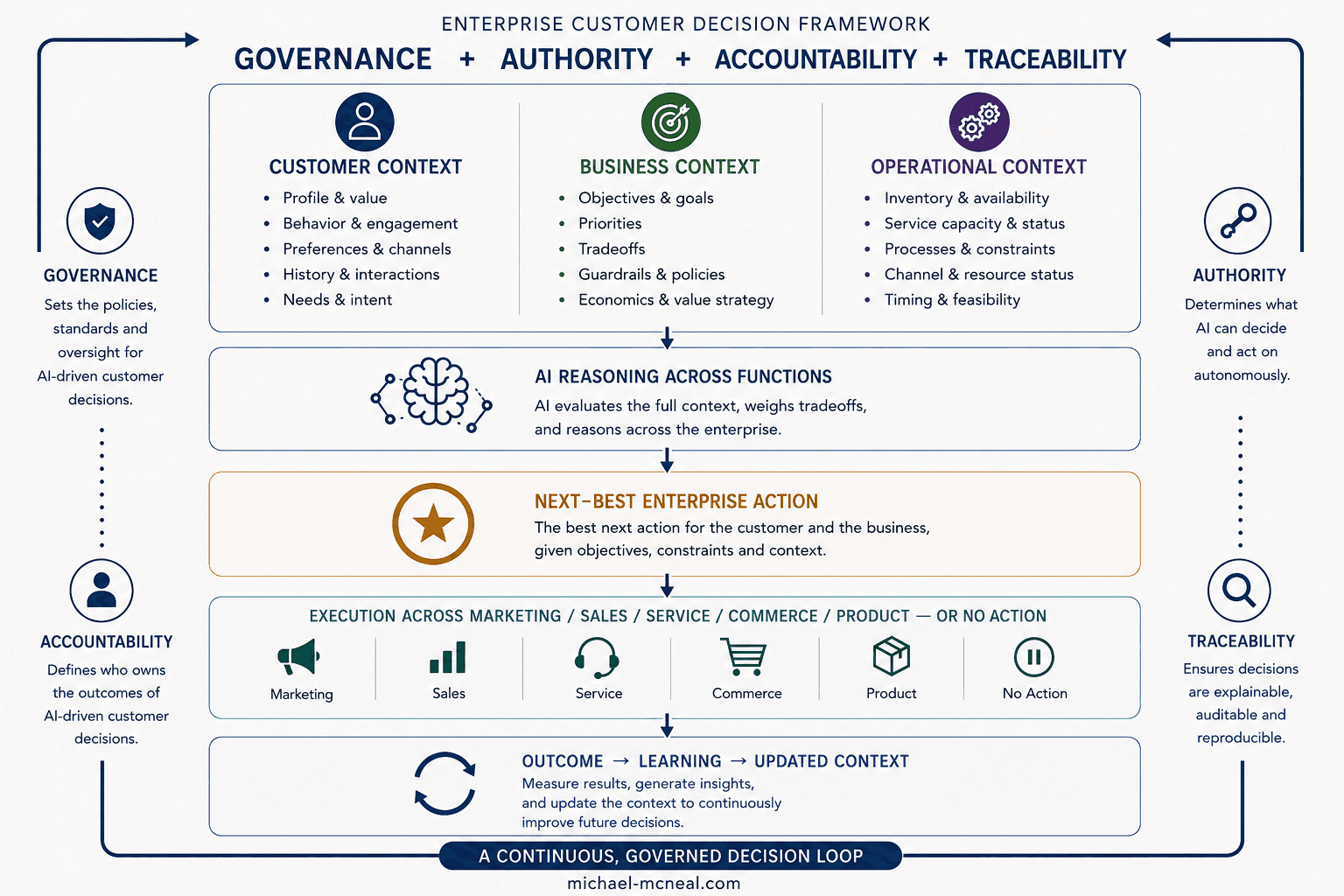
Surrounding that decision loop are governance, authority, accountability and traceability.
As AI begins making decisions rather than simply generating recommendations, organizations need visibility into how those decisions are made: the context that influenced them, the objectives being optimized, the authority AI was given, and who ultimately remains accountable for the outcome.
The risk of making the silos smarter
There is another possible future.
This fragmentation doesn’t necessarily result from a deliberate AI strategy. It may emerge naturally as organizations adopt the AI capabilities increasingly embedded in the platforms their Marketing, Sales, Service, Commerce and Product teams already use.
Those capabilities will continue getting better. Marketing platforms will become better at determining which customers to engage and how. CRM platforms will become better at identifying sales opportunities and prompting action. Service platforms will become better at determining how and when customer issues should be addressed. Commerce platforms will become better at optimizing transactions.
Each can produce a better decision within its domain.
But therein lies the problem:
The AI embedded in an individual platform may be very good at determining the next-best action available within that platform. The bigger question is whether that’s also the best next action across the customer relationship and for the business as a whole.
A marketing agent could correctly determine that a high-value customer should receive a retention offer. A service agent could correctly determine that the same customer’s unresolved issue requires immediate attention. A sales agent could see increased activity and correctly recommend outreach.
Each AI could be right according to the context, objectives and actions available within its environment.
And the company could still be wrong as a whole. The problem isn’t necessarily the intelligence of any individual AI. It’s whether the decision is being made for a function or across the customer relationship.
One risk of enterprise AI is therefore that it makes existing organizational and technology silos more intelligent without necessarily overcoming them.
The opposite risk: AI gets ahead of the operating model
The opposite risk is giving AI greater authority before the organization has established how that authority should work. Even with rich customer, business and operational context, including clear objectives, priorities, tradeoffs and guardrails—there remains a question of authority: which decisions AI can make autonomously, which actions require human approval, and when AI should defer to another function or escalate a decision.
As AI takes on greater decision-making authority, accountability and traceability become increasingly important. Who owns the outcome of an AI-driven customer decision? And can the organization understand the context and reasoning that led to it?
The challenge isn’t simply giving AI enough context to make a good decision. It’s determining how much authority AI should have to act on it, who remains accountable for the outcome, and whether the decision can be understood after the fact.
Customer ownership can be shared. Decision ownership can’t be ambiguous.
This doesn’t necessarily mean companies need to appoint a single executive to “own the customer.”
Customer relationships inherently span functions. Shared ownership may be both inevitable and appropriate. But AI makes customer decision ownership increasingly important.
Organizations need clarity about the objectives and priorities AI should operate against, the tradeoffs and guardrails it should respect, the authority it has to act, when decisions should escalate to people, and who remains accountable for the outcome.
That doesn’t necessarily require a new organizational structure, but it does require an explicit customer decision framework—and the ability to trace the decisions made within it.
What does this mean for Marketing?
Marketing has an important role to play, but I don’t think the answer is that Marketing should simply claim sole ownership of the customer. As customer decisions increasingly cross Marketing, Sales, Service, Commerce and Product, no individual function has all the context or objectives required.
Marketing does, however, bring capabilities that become particularly important: understanding customers, managing lifecycle and engagement, defining customer value, balancing short-term response with long-term relationships, protecting the brand, and managing engagement across channels and moments rather than individual campaigns.
That gives Marketing an opportunity to help define the customer strategy against which AI makes decisions, even when the resulting action happens outside Marketing.
Toward a customer operating model for AI
The technology required to support this future will continue evolving.
Customer data platforms, CRM, customer engagement platforms, commerce, service, product systems, enterprise data platforms and AI platforms may all contribute pieces of the context and execution layer.
That creates an implementation challenge as well as an operating-model challenge. Even if an organization establishes how AI should make customer decisions, those decisions may need to draw context from—and ultimately be executed across—multiple platforms.
Technology alone won’t resolve the underlying issue. But neither will an AI operating model that can’t be translated into how the organization’s technology really works.
The challenge is connecting the two: establishing how customer context, business objectives and AI decisioning should work across functional boundaries, and then enabling the technology to support it.
That suggests five questions CEOs and leadership teams should begin asking:
Which customer decisions do we want AI to make?
Does AI have access to the customer, business and operational context required to make them well?
Are our AI systems optimizing functional outcomes or enterprise customer outcomes?
Which decisions can AI make autonomously, and when should people intervene?
Can we trace why an AI-driven customer decision was made, and who is ultimately accountable for the outcome?
The old question isn’t going away
The old question of who owns the customer isn’t going away. The customer relationship is too broad to fit neatly within any one function, and shared ownership will continue to be a reality for many organizations.
As AI takes on more of the decisions across that relationship, ownership of the customer may no longer be the question that matters most. Leadership teams will need to define who owns the decisions being made about the customer, and how those decisions should be made.
So perhaps the question for the AI era isn't really:
Who owns the customer?
The more consequential question may be:
Who owns the decisions being made about the customer?
As more of those decisions are made by AI, answering that question becomes increasingly difficult to avoid.
“Who owns the customer?” isn’t a new question. Organizations have debated it for decades.
Marketing may own customer strategy and engagement. Sales owns much of the commercial relationship. Service owns critical moments in the customer experience. Commerce owns transactions. Product increasingly owns the digital experience.
In most organizations, the practical answer has been some version of everyone—and no one.
That ambiguity hasn’t prevented companies from operating. But AI may make it much harder to sustain.
As AI moves from helping employees create and analyze toward making decisions and taking actions, it can increasingly operate across the functional boundaries companies have traditionally built around the customer.
That creates an opportunity to make better decisions across the customer relationship—and raises a more consequential version of the old question:
"Who owns the customer decision when AI operates across functions?"
Customer decisions are still largely made inside functional boundaries
Consider how companies engage with customers today.
Marketing determines which audiences to target, which messages to send and when to engage.
Sales decides which opportunities or accounts require attention.
Service prioritizes customer issues and determines how they should be resolved.
Commerce recommends products, offers and promotions.
Product and Customer Success teams increasingly influence onboarding, adoption and digital engagement.
Each function has its own objectives, systems, data and metrics, and each can make a perfectly rational decision within its own domain.
The problem is that customers don’t experience the company as a collection of functional departments. They don’t distinguish between a marketing message, a sales call, a service interaction and a product notification. They’re all interactions with the same company, and customers increasingly expect the company to understand the broader relationship—not just the part visible to an individual function.
As AI becomes increasingly capable of understanding the broader customer relationship, it creates the possibility of moving beyond the next-best action within a function toward something potentially more valuable: the next-best enterprise action.
By “next-best enterprise action,” I mean the best next action determined across the customer relationship and against the broader objectives of the business, rather than within the boundaries of a single function. That action might ultimately be executed through Marketing, Sales, Service, Commerce or Product—or the best decision may be to take no action at all.
What is the best thing for the company to do next?
Consider a high-value customer whose likelihood of repurchase has begun to decline.
They have an unresolved customer-service issue.
They recently viewed a product they’ve purchased before.
The price of that product has increased, and it’s currently unavailable.
A recent promotional offer didn’t generate engagement.
Their preferred communication channels are known.
Another automated process contacted them yesterday.
A mature customer platform may already contain much of this information or be able to access it.
And increasingly, a capable AI shouldn’t need a marketer to separately ask:
Should we contact this customer?
Why haven’t they repurchased?
What retention offer should we make?
Given sufficient context, the AI should increasingly be able to reason across those questions itself.
It might conclude that the customer’s declining repurchase probability doesn’t necessarily indicate deteriorating loyalty.
Recent product browsing suggests continued interest.
Product availability or the price increase may be suppressing purchase.
The unresolved service issue makes another promotional message potentially inappropriate.
And recent automated engagement suggests another immediate interaction could make the experience worse rather than better.
The best next action might therefore not be a marketing action at all.
It could be to prioritize the service issue, wait for the product to become available, prompt another part of the organization to act, or simply do nothing for now.
That is a fundamentally different conception of next-best action.
The question becomes: What is the best thing for the company to do next with this customer? Not simply the best thing for Marketing, Sales or Service, but the best enterprise action given the customer and business circumstances.
The difficult word is “best”
This sounds straightforward until we ask what best actually means.
Revenue? Margin? Conversion?
Retention? Customer lifetime value? Customer experience?
Service resolution? Product adoption? Brand?
Those objectives won’t always point toward the same action.
A marketing system might identify a high-value customer with declining repurchase probability and recommend an aggressive retention offer. A service system might recommend suppressing commercial communication until the customer’s problem is resolved. Commerce might identify continued purchase intent and recommend an alternative product. Finance might determine that additional discounting would destroy too much margin.
Each answer can be rational.
And an increasingly capable AI may be able to model those competing considerations and determine which action is most likely to produce a particular outcome.
But the organization still needs to establish what it means by a good outcome.
That requires, explicitly or implicitly:
Objectives → Priorities → Tradeoffs → Guardrails
AI can increasingly determine what it knows, what matters and what action is likely to produce an outcome.
But it still needs a framework for determining which outcomes the organization values and what boundaries apply in pursuing them.
Context enables cross-functional decision-making
For AI to make these decisions well, it needs more than customer data alone.
It needs sufficiently rich customer, business and operational context.
Customer context might include behavior, transactions, engagement history, lifecycle, preferences, relationships and previous interactions.
Business context can include objectives, economics, customer-value strategy, brand principles, policies and commercial priorities.
Operational context might include product availability, service status, capacity, fulfillment or other conditions that affect what the company can—or should—do.
Together, that creates a decision model:

Surrounding that decision loop are governance, authority, accountability and traceability.
As AI begins making decisions rather than simply generating recommendations, organizations need visibility into how those decisions are made: the context that influenced them, the objectives being optimized, the authority AI was given, and who ultimately remains accountable for the outcome.
The risk of making the silos smarter
There is another possible future.
This fragmentation doesn’t necessarily result from a deliberate AI strategy. It may emerge naturally as organizations adopt the AI capabilities increasingly embedded in the platforms their Marketing, Sales, Service, Commerce and Product teams already use.
Those capabilities will continue getting better. Marketing platforms will become better at determining which customers to engage and how. CRM platforms will become better at identifying sales opportunities and prompting action. Service platforms will become better at determining how and when customer issues should be addressed. Commerce platforms will become better at optimizing transactions.
Each can produce a better decision within its domain.
But therein lies the problem:
The AI embedded in an individual platform may be very good at determining the next-best action available within that platform. The bigger question is whether that’s also the best next action across the customer relationship and for the business as a whole.
A marketing agent could correctly determine that a high-value customer should receive a retention offer. A service agent could correctly determine that the same customer’s unresolved issue requires immediate attention. A sales agent could see increased activity and correctly recommend outreach.
Each AI could be right according to the context, objectives and actions available within its environment.
And the company could still be wrong as a whole. The problem isn’t necessarily the intelligence of any individual AI. It’s whether the decision is being made for a function or across the customer relationship.
One risk of enterprise AI is therefore that it makes existing organizational and technology silos more intelligent without necessarily overcoming them.
The opposite risk: AI gets ahead of the operating model
The opposite risk is giving AI greater authority before the organization has established how that authority should work. Even with rich customer, business and operational context, including clear objectives, priorities, tradeoffs and guardrails—there remains a question of authority: which decisions AI can make autonomously, which actions require human approval, and when AI should defer to another function or escalate a decision.
As AI takes on greater decision-making authority, accountability and traceability become increasingly important. Who owns the outcome of an AI-driven customer decision? And can the organization understand the context and reasoning that led to it?
The challenge isn’t simply giving AI enough context to make a good decision. It’s determining how much authority AI should have to act on it, who remains accountable for the outcome, and whether the decision can be understood after the fact.
Customer ownership can be shared. Decision ownership can’t be ambiguous.
This doesn’t necessarily mean companies need to appoint a single executive to “own the customer.”
Customer relationships inherently span functions. Shared ownership may be both inevitable and appropriate. But AI makes customer decision ownership increasingly important.
Organizations need clarity about the objectives and priorities AI should operate against, the tradeoffs and guardrails it should respect, the authority it has to act, when decisions should escalate to people, and who remains accountable for the outcome.
That doesn’t necessarily require a new organizational structure, but it does require an explicit customer decision framework—and the ability to trace the decisions made within it.
What does this mean for Marketing?
Marketing has an important role to play, but I don’t think the answer is that Marketing should simply claim sole ownership of the customer. As customer decisions increasingly cross Marketing, Sales, Service, Commerce and Product, no individual function has all the context or objectives required.
Marketing does, however, bring capabilities that become particularly important: understanding customers, managing lifecycle and engagement, defining customer value, balancing short-term response with long-term relationships, protecting the brand, and managing engagement across channels and moments rather than individual campaigns.
That gives Marketing an opportunity to help define the customer strategy against which AI makes decisions, even when the resulting action happens outside Marketing.
Toward a customer operating model for AI
The technology required to support this future will continue evolving.
Customer data platforms, CRM, customer engagement platforms, commerce, service, product systems, enterprise data platforms and AI platforms may all contribute pieces of the context and execution layer.
That creates an implementation challenge as well as an operating-model challenge. Even if an organization establishes how AI should make customer decisions, those decisions may need to draw context from—and ultimately be executed across—multiple platforms.
Technology alone won’t resolve the underlying issue. But neither will an AI operating model that can’t be translated into how the organization’s technology really works.
The challenge is connecting the two: establishing how customer context, business objectives and AI decisioning should work across functional boundaries, and then enabling the technology to support it.
That suggests five questions CEOs and leadership teams should begin asking:
Which customer decisions do we want AI to make?
Does AI have access to the customer, business and operational context required to make them well?
Are our AI systems optimizing functional outcomes or enterprise customer outcomes?
Which decisions can AI make autonomously, and when should people intervene?
Can we trace why an AI-driven customer decision was made, and who is ultimately accountable for the outcome?
The old question isn’t going away
The old question of who owns the customer isn’t going away. The customer relationship is too broad to fit neatly within any one function, and shared ownership will continue to be a reality for many organizations.
As AI takes on more of the decisions across that relationship, ownership of the customer may no longer be the question that matters most. Leadership teams will need to define who owns the decisions being made about the customer, and how those decisions should be made.
So perhaps the question for the AI era isn't really:
Who owns the customer?
The more consequential question may be:
Who owns the decisions being made about the customer?
As more of those decisions are made by AI, answering that question becomes increasingly difficult to avoid.
More Insights
Why Positioning Matters More in an AI-Mediated Market
Who Owns the Customer in the Age of AI?
Let's Connect
Whether you'd like to discuss an executive opportunity, advisory or board role, speaking engagement, or simply start a conversation, I'd be happy to hear from you.
Let's Connect
Whether you'd like to discuss an executive opportunity, advisory or board role, speaking engagement, or simply start a conversation, I'd be happy to hear from you.